Swing Door Safety
Specifying automatic swing doors? The hinge-side pinch zone is the risk most often missed. Here's how to close it.
 MF Services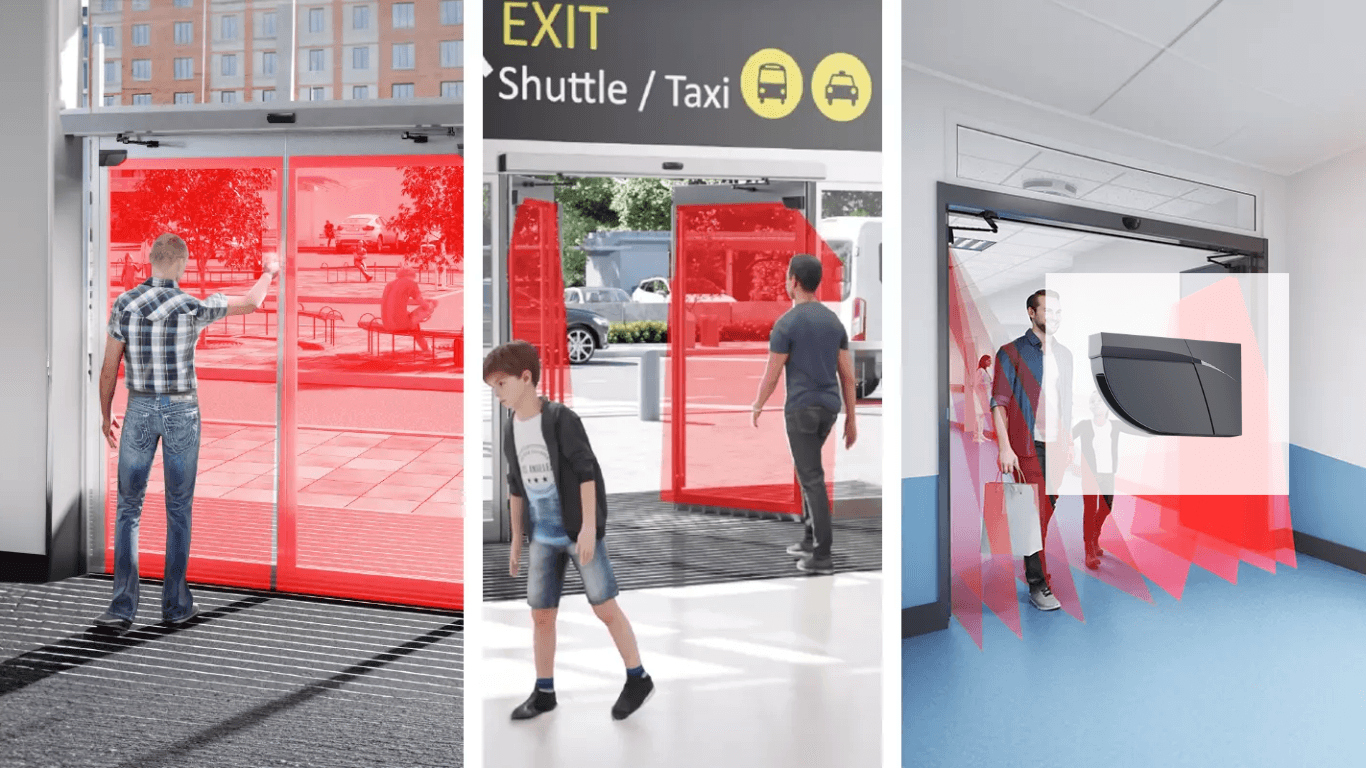
Specifying automatic swing doors? The hinge-side pinch zone is the risk most often missed. Here's how to close it.
A power-operated swing door closes hundreds of times a day. Every cycle, the secondary closing edge at the hinge opens and shuts like a pair of shears. For a child in a school corridor, an elderly visitor in a care home, or anyone reaching to steady a door, that pinch zone is where serious finger injuries happen.
It’s also the part of the door safety specification most easily overlooked. The main leaf is routinely addressed, while the hinge-side closing edge gets less attention than the risk deserves.
MF Services specifies, supplies and installs complete swing door safety solutions — combining EN 16005-compliant laser sensing with the right protective hardware, so the whole door is genuinely safe, not just the obvious part of it. Here’s how it works, and what it means for your specification.
the standards it's specified to meet
rotating mirror scanning leaf and secondary closing edge
maximum laser detection range
rated for demanding door environments
EN 16005 is the European standard for safety in use of power-operated pedestrian doors. It’s the benchmark Irish specifiers are measured against, and it’s explicit on one point that often gets missed: a power-operated door must protect users from crushing, shearing and drawing-in hazards across its whole movement — not just the main opening.
On a swing door, that means the hinge-side secondary closing edge is squarely in scope. A specification that addresses the leaf but treats the closing edge as an afterthought is not a complete EN 16005 response — and that gap can surface late, at sign-off or inspection, when it’s expensive and disruptive to correct.
A complete solution removes that risk: EN 16005-compliant laser monitoring of the leaf and closing edge, combined — in public buildings — with appropriate finger protection. For healthcare, education and public projects, where both the pinch-zone risk and the compliance scrutiny are highest, that complete approach should be the default position, not an upgrade.

A power-operated swing door has to be safe across its whole movement — the main leaf and the secondary closing edge at the hinge. The ECO Schulte Flatscan 2D addresses both. It’s a two-module laser sensor set — one module for the hinge side, one for the opposite side — each with an integrated mirror rotating through 360° to continuously monitor door leaf movement and the closing edge, compliant with EN 16005.
In public buildings, MF Services specifies it the way the manufacturer intends: as part of a complete pinch-zone solution, paired where appropriate with dedicated finger protection. The sensor housing is compact — 85 × 142 mm — and available in black, white or silver to sit discreetly against the door.
The result is a swing door that is genuinely safe at the closing edge, fully compliant, and specified as one coherent solution rather than assembled from afterthoughts.
A two-page reference covering the EN 16005 standard, the closing-edge specification, and the specifier questions architects ask most often. Save it for project meetings, share it with colleagues, or attach it to your specification notes.

A compact 85 × 142 mm housing, available in black, white or silver. The sensor sits quietly against the door, so the finished opening reads the way you detailed it

IP54-rated, a wide operating temperature range, a self-programming wall fade-out function and adjustable tilt — engineered to perform reliably across demanding door environments.

MF Services specifies the sensor and the right protective hardware together — a coherent EN 16005-compliant solution for the whole closing edge, not a part of it.
It monitors door leaf movement and the hinge-side secondary closing edge of power-operated swing doors. The set comprises two laser modules — one for the hinge side, one for the opposite side — each using an integrated 360° rotating mirror, compliant with EN 16005.
Traditional mechanical finger guards — the roll-up or concertina covers fitted over the hinge gap — have been the standard answer for years, and they still have a role. But specifiers know their drawbacks: they wear, work loose or jam over time, they need maintenance, and the fabric and PVC types are difficult to keep clean, which is a real concern in healthcare and education settings.
The Flatscan 2D takes a different approach. It provides electronic detection of the closing edge — a 360° laser scan rather than a physical barrier — so there is nothing mechanical to wear out or harbour dirt. It reduces reliance on mechanical guarding and brings the installation up to a modern, low-maintenance, hygienic standard.
In most cases, yes — it’s a practical way to bring an existing power-operated swing door’s safety provision up to standard, and a clean way to move away from ageing mechanical guards. Send us the door details and we’ll confirm suitability for your specific situation.
The Flatscan 2D set is available in black, white and silver. A dedicated protective hood is also available in anodised or black-painted aluminium, in left and right models, where added protection of the sensor itself is required.
It is compliant with EN 16005 — the European standard for safety in use of power-operated pedestrian doors, and the benchmark for swing door safety specification in Ireland.
Yes. We work with architects and specifiers from early design through to installation and aftercare. Send drawings, a sample specification, or an outline of the project and we’ll come back with recommendations, datasheets and indicative pricing.

High door traffic and vulnerable users make the closing edge a real risk. Complete swing door safety is a duty-of-care essential in hospitals, clinics and care settings.

Schools and colleges put children and constant footfall through the same doors every day. Proper closing-edge protection belongs in the specification from the outset.

Offices, civic buildings and transport hubs carry both the compliance scrutiny and the user-safety obligation. A complete EN 16005 solution protects the building and its occupants.
Whether you’re at concept stage or finalising a door schedule, we’ll help you get swing door safety right. Send us drawings, a sample specification or an outline of the project, and we’ll come back with recommendations, datasheets and indicative pricing.
You’ll also find us at Architecture Expo 2026, Stand B25, RDS Dublin, 7–8 October — come and see the system in person and talk through your current projects with the team.
MF Services
Unit 26 Doughcloyne Court Industrial Estate,
Sarsfield Road,
Wilton, Cork, Ireland.


