Commercial Door Closers Ireland
Types, Standards & Selection Guide
 MF Services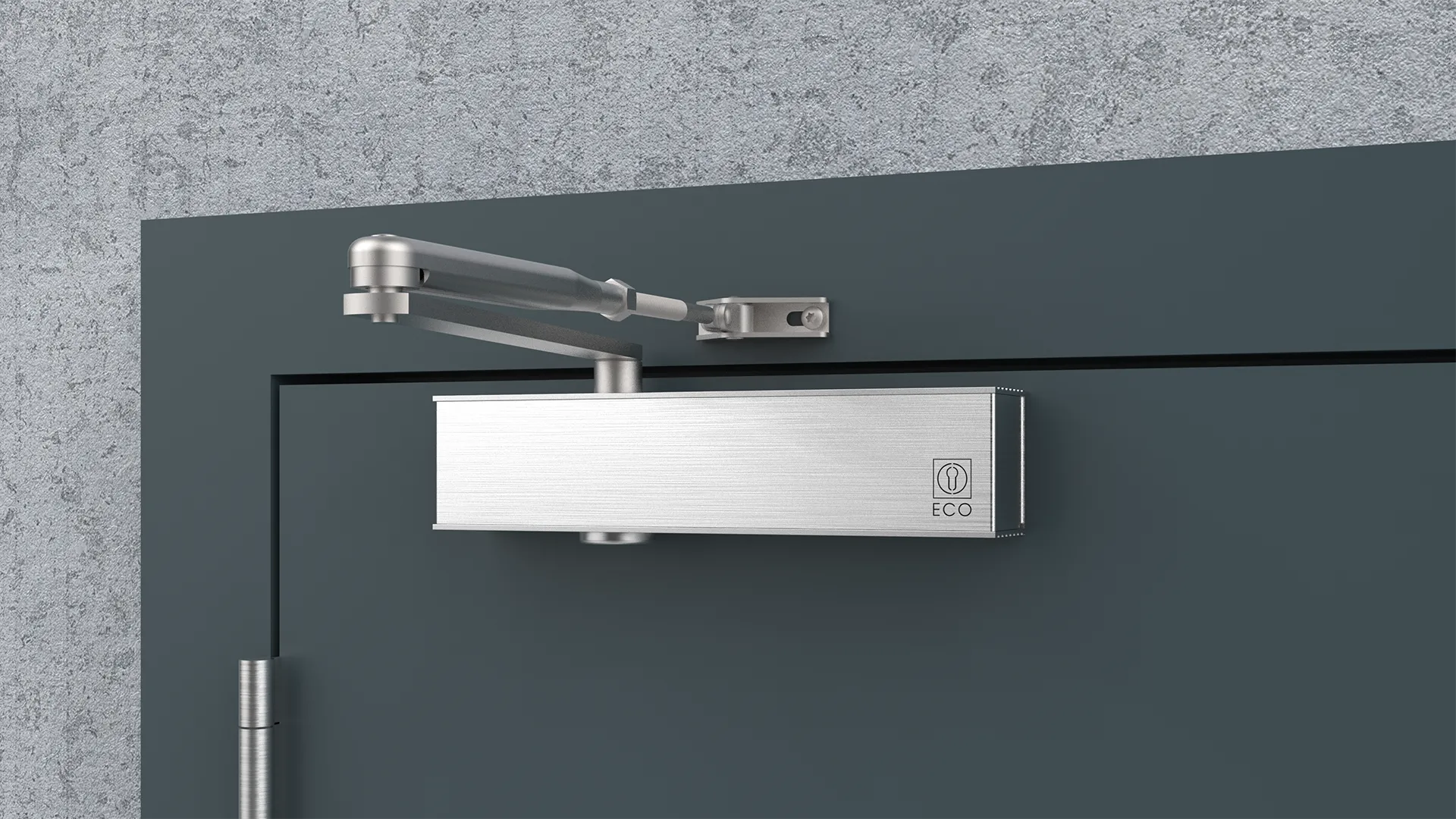
Types, Standards & Selection Guide
For property managers, facilities teams, and architects across Ireland, ensuring the safety, accessibility, and operational flow of a building often relies on the smallest hardware details. When outfitting a corporate office, a bustling hospital, or a retail hub, your mind naturally turns to high-level security systems, energy bills, and aesthetic finishes. Yet, one foundational element frequently taken for granted is the humble door closer.
Far from being a simple mechanical arm, the correct closing device protects property, preserves energy, and acts as a life-saving mechanism during emergency situations. In commercial environments, doors are subjected to hundreds, if not thousands, of operations daily. Without a high-performing control mechanism, doors can slam violently, cause serious injuries, compromise acoustic boundaries, or fail to latch entirely—rendering your expensive access control systems utterly useless.

Selecting the right physical format for your hardware is the first step toward a secure and durable installation.
Commercial spaces feature incredibly diverse functional and aesthetic demands, meaning a one-size-fits-all approach simply does not work.
The industry categorises these mechanisms into three primary configurations based on their mechanical layouts and mounting positions, each serving a distinct architectural purpose.
The overhead door closer stands as the undisputed workhorse of commercial real estate. Mounted prominently at the top of the door leaf or transom, these units rely on a robust internal spring and hydraulic fluid to control movement. If you opt for a standard scissor arm (or projecting arm) configuration, you get a highly efficient, cost-effective, and mechanically forgiving system perfect for office corridors and plant rooms. On the other hand, selecting a slide arm (or cam-action) configuration gives you a low-profile track system mounted directly to the frame. This design requires significantly less opening force, making it highly accessible while offering a sleek appearance that minimises the risk of vandalism in public spaces. You can explore these high-traffic options in our comprehensive catalogue of certified door closers.
Floor springs take a completely different approach by shifting the mechanical burden downward. These heavy-duty units are embedded directly into the concrete floor slab beneath the entryway. Because the entire weight of the door leaf rests on a floor-mounted pivot rather than standard frame hinges, floor springs are uniquely suited for handling exceptionally heavy timber entries, massive double-action doors that swing both inwards and outwards, and frameless architectural glass doors. They are the premier choice for corporate building lobbies, shopping centre entrances, and prestigious hotels where clean lines and ultimate durability are essential.
Concealed door closers step in when design-led commercial spaces, luxury environments, and modern residential developments require aesthetics to match performance. These systems are morticed directly into the door leaf and frame, remaining completely hidden from sight when the entryway is shut. This layout preserves the clean architectural profile of premium spaces while physically protecting the closing mechanism from external environmental factors, dust, or intentional tampering.
We have all experienced that jarring, teeth-rattling slam of a commercial door echoing down a corridor. It isn't just an acoustic nuisance; it is the sound of your building’s structural integrity taking a beating. Substituting residential-grade hardware into a business environment quickly leads to component fatigue, safety hazards, and premature failure. Investing in a high-specification commercial door closer is an essential operational strategy.

Commercial entryways endure immense physical strain that domestic hardware cannot tolerate. In environments like hospitals, transport hubs, and educational institutes, doors open and close millions of times per year. A certified, professional-grade mechanism is engineered with precision-machined internal components, specialised seals, and high-tensile springs designed to withstand this constant cycling without losing hydraulic tension or leaking fluid.

Uncontrolled doors can damage frames, loosen hinges, and crack surrounding walls over time. Premium commercial door closers help prevent this with two key features. Backcheck (BC) slows the door during opening to protect it from strong impacts, while Delayed Action (DA) keeps the door open briefly before closing, allowing wheelchair users, trolleys, and goods to pass through safely.

Uncontrolled doors can damage frames, loosen hinges, and crack surrounding walls over time. Premium commercial door closers help prevent this with two key features. Backcheck (BC) slows the door during opening to protect it from strong impacts, while Delayed Action (DA) keeps the door open briefly before closing, allowing wheelchair users, trolleys, and goods to pass through safely.
When specifying a door closer Ireland features unique legislative frameworks that must be followed. Compliance with Irish building regulations is mandatory, and failure to install certified hardware can result in severe legal liabilities and invalidated insurance policies. Think of the European standard BS EN 1154 as your compliance cheat sheet—a strict 6-digit coding system that determines exactly what a device is capable of handling.
Digit 4 is your absolute red line when dealing with safety. For any fire-rated application in Ireland, Digit 4 must strictly register as a Grade 1. A Grade 0 rating means the device has not been tested to withstand high-temperature conditions, making it completely non-compliant for use on fire containment partitions.
Under Ireland’s Technical Guidance Document B (TGD B), fire doors act as critical compartmentation barriers designed to restrict the spread of toxic smoke and fire. A fire door can only perform its life-saving function if it is securely closed at the moment of an emergency. Therefore, TGD B mandates that all non-locked compartmentation doors must be fitted with an active, certified self-closing device capable of overcoming the resistance of latches and seals from any angle.
While TGD B demands strong closing forces, Technical Guidance Document M (TGD M) focuses on accessibility, ensuring that buildings can be safely navigated by everyone, including people with disabilities or limited upper-body strength. This creates a functional challenge: a closer must be strong enough to shut a door against wind pressure, yet light enough to open easily. To achieve this balance, modern facilities install high-efficiency cam-action systems or variable-power closers. These units display a rapidly dropping opening resistance curve, providing maximum force during the final latching phase while keeping the initial opening pressure well within accessible limits.
Selecting a certified fire door closer requires careful consideration of mechanical specifications and environmental demands. You cannot simply pick a device based on appearance; you must match the hardware to the physical parameters of the entryway itself.
The closing force of a device is measured in EN power sizes, ranging from 1 to 7, which scale directly with the physical width and weight of the door leaf. For instance, an EN Size 3 is designed for doors up to 950mm wide and weighing up to 60kg, while an EN Size 5 jumps up to handle doors up to 1250mm wide and weighing up to 100kg. According to EN 1154 Annex A, power sizes below EN 3 are considered mechanically insufficient to reliably overcome the resistance of intumescent fire seals and latches. Consequently, any closer set to or rated below EN 3 is illegal for use on fire-rated doors.
In high-traffic areas like school corridors or hospital main arteries, keeping doors constantly closed impedes daily operations and accelerates hardware wear. To solve this, facilities install electromagnetic hold-open closers. These devices use an integrated electromagnet to securely hold the door open during normal operations. The system is linked directly to the building’s central fire alarm panel; the moment smoke or fire is detected, power to the magnet cuts off instantly, allowing the mechanical internal spring to close the door and seal the fire compartment.
Even the highest-quality, multi-certified closing mechanism will fail to meet safety requirements if it is poorly installed. Minor installation misalignments, incorrect arm geometry, or over-tightened regulating valves can quickly lead to accelerated wear, oil leaks, and failure to latch. Routine professional maintenance and compliance audits are essential. In line with modern life safety practices, facilities should inspect all self-closing safety mechanisms at intervals of no less than three months to guarantee total operational readiness.
A closing mechanism does not operate in isolation. It forms the foundation of a building’s broader, interconnected security and fire protection ecosystem. To ensure full protection, hardware must work seamlessly with your building’s entryways and security installations.
When a fire door closer does its job seamlessly, it preserves the performance of your entire fire-resistant doors investment. When smoke or flame triggers an evacuation, the closer must provide enough force to pull the door firmly into its frame. This action allows the heat-activated intumescent strips around the frame to expand properly, creating a tight seal that blocks toxic gases from entering escape routes.
For heavy-duty security doors, a premium closer is equally essential for access control integrity. If a door remains slightly ajar after a staff member passes through, magnetic locks and electronic deadbolts cannot engage, leaving the building vulnerable to unauthorised entry. Specifying a closer with an adjustable latching action guarantees the door latches securely every time, maintaining building security.
During an emergency evacuation, exit pathways must remain completely unobstructed. While the closer must secure the entryway after use to prevent fire spread, it must not create excessive physical resistance that counteracts the instant release functionality of your panic and emergency hardware. Ensuring that panic bars, emergency escape latches, and closing controls are properly balanced allows occupants to exit the building quickly and safely without delay.
Selecting, configuring, and installing commercial door hardware is a highly specialised task with significant safety implications. Because every building features a unique combination of door weights, architectural designs, pedestrian traffic levels, and fire safety demands, standard off-the-shelf solutions are rarely sufficient.
At MF Services, we understand that commercial hardware specifications rely on a variety of bespoke variables. To ensure your building receives the exact equipment required for long-term performance and legal compliance, our team provides tailored advice and comprehensive on-site inspections. Rather than using generic pricing models, we build customised solutions designed around your property’s specific configuration.
With over 50 years of combined team expertise helping businesses across Ireland secure and optimise their commercial properties, MF Services stands as a premier provider of smart security and hardware solutions. Our operations are fully ISO 9001 accredited and Private Security Authority (PSA) certified, ensuring that every installation meets the highest quality and regulatory standards. Backed by a nationwide support network of highly trained engineers, we manage everything from initial safety compliance audits to large-scale hardware replacements.
Ensure your property remains safe, secure, and fully compliant with Irish building regulations. Contact our specialist engineering team today to schedule a dedicated compliance consultation or to request a bespoke project estimate.
MF Services
Unit 26 Doughcloyne Court Industrial Estate,
Sarsfield Road,
Wilton, Cork, Ireland.

